Sunday, 19 March 2017

Our next books

Images may be subject to copyright

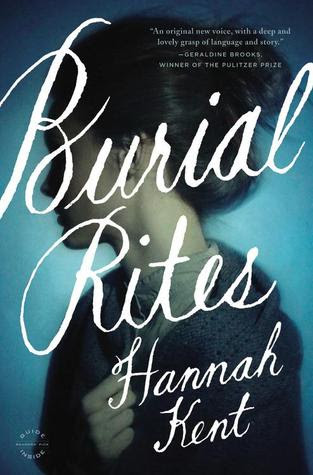
Burial Rites and The Sea

The Wolfon Contemporary Reading Group will next meet on Wednesday, 3 May at the usual time of 7:30pm in Plommer A. We will be discussing two books at the meeting and you are welcome to read one or both.

Burial Rites, Hannh Kent (2013)


Northern Iceland, 1829.

A woman condemned to death for murdering her lover.

A family forced to take her in.

A priest tasked with absolving her.

But all is not as it seems, and time is running out: 
winter is coming, and with it the execution date.

Only she can know the truth. This is Agnes's story

The Sea, John Banville (2004)

When art historian Max Morden returns to the seaside village where he once spent a childhood holiday, he is both escaping from a recent loss and confronting a distant trauma. The Grace family had appeared that long-ago summer as if from another world. Mr and Mrs Grace, with their worldly ease and candour, were unlike any adults he had met before. But it was his contemporaries, the Grace twins Myles and Chloe, who most fascinated Max. He grew to know them intricately, even intimately, and what ensued would haunt him for the rest of his years and shape everything that was to follow.

____________________________________

We really hope that you will join us in May - the participation of our members is what keeps the Reading Group alive. However, if you are unable to be with us, please email your comments and scores so that they can be shared with the group.

The book is available in local libraries, and in paperback and Kindle edition from Amazon* and other booksellers.


*Please remember to use the link on the Wolfson Alumni & Development website if you choose to buy from Amazon, as College will benefit from the sale: http://www.wolfson.cam.ac.uk/alumni/amazon/ 

March review: 'Golden Hill', by Francis Spufford

Image may be subject to copyright


Book: Golden Hill, Francis Spufford

Publication date: 2016

WCRG meeting: 8 March 2017

Rating: 7.8


Thank you to all who either attended the meeting in person, or submitted their reviews in advance at our last meeting on 8 March where we discussed Golden Hill, by Francis Spufford. We had a lively evening discussing the book.

A young man, Richard Smith, arrives on the brig Henrietta in small-town, colonial New York in 1746 bearing a bill for the sum of £1000 expecting to exchange it for cash from a trader, Mr Lovell, who owes this amount to the London company that wrote the bill. He won't say how he will use this enormous sum of money and even the reader is not enlightened until the very end of the book. Mr Lovell is understandably nervous and awaits confirmation from the London company by ship.

So begins a rollicking, picaresque rom-com of a book with more than a nod towards Tristram Shandy and Tom Jones with characters straight out of a Hogarth engraving, helped, or possibly hindered, by being written in the style of an 18th century novel with its use of archaic words, period punctuation and turns of phrase. Even the chapters are numbered and dated with the accession date of George II. This is pre-revolutionary America and everyone, to a man, is proud of being British.

After twenty years of writing non-fiction, this is Francis Spufford's first novel and he has managed to create vivid scenes of 18th century street and salon life that draws the reader into a world of commerce in which money and mistrust underlie everything. Comparisons between New York (a town of 7,000) and London, (one hundred times bigger) help to set the scene. New York is conveyed from Smith’s point of view - he thought the populace healthier and it was a rarity to see three women not marked by smallpox.

The Reading Group were greatly energised by their discussion though not necessarily because it was universally liked. Some thought that just too much was happening, and though hugely enjoyable at times it wasn't always clear just how it all hung together. The initial MacGuffin, the promissory note, is largely forgotten until the very end. In between its initial appearance and its conversion into hard cash, we have Smith helping to produce and perform in a theatrical play; almost beaten to a pulp at an anti-Papist bonfire followed by the mob chasing him through the streets and then roof-tops; fighting a duel; imprisoned for debt and then for murder; and steamy sex in a bathhouse. It was felt that a second reading would help make events clearer and one member had done this (and consequently almost doubled his score by doing so) but even then some connecting elements of the story were missed and it was only in the group discussion that the riot of action could be slowed and unpicked. Some members were put off by the mannered style of writing, while for others this was the real joy of the book.

The characters were very finely drawn, none being especially sympathetic, and some in fact were downright malicious but all were believable. Septimus Oakeshott, Secretary to the Governor was probably the most decent but even he was known to be a spy and would find out what was going on by any means at his disposal. The attraction between Smith and Tabitha was compared by themselves to that of Beatrice and Benedict and in the final chapter headed August 1813 with Tabitha now an elderly spinster, she sets down the events of that tumultuous period 67 years ago when Smith arrived and left with his (WARNING: PLOT SPOILER) sledges of slaves bought at the market, to start a new life of freedom. Tabitha can't help reveling in the fact that her father was taken in by Smith and that he had (WARNING: ANOTHER PLOT SPOILER) “entertained a n....r unawares" and "pressed upon him the society of his daughters". And when the laughter of others had died away "that judge, lawyer and jury had excused a black man for the death of a white one......that the assembly had thought him worth wooing.......he had been treated as a person of consequence....That Terpie had---- Well; enough of that." Tabitha belatedly becomes more human and is now living in post-revolutionary America as she perceives that she has moved from living in one epoch to another, both mutually unintelligible. She admits she has grown no nicer but her contrariness has diminished into a more easily domesticated form - but she remembers how good it was to scream!

All in all the book provoked a great deal of debate. All our members were impressed by this novelistic debut but some more than others. The final score of 7.8 reflects that a few marks were low but many were high.

Saturday, 21 January 2017

March 2017: Our next book

Image may be subject to copyright

Golden Hill, Francis Spufford

The Wolfon Contemporary Reading Group will next meet on Wednesday, 8 March at the usual time of 7:30pm in Plommer A. All are welcome to come along to our discussion of Golden Hill, by Francis Spufford - the winner of the Costa First Novel Award in 2016.

From Amazon.co.uk:


New York, a small town on the tip of Manhattan island, 1746.
One rainy evening in November, a handsome young stranger fresh off the boat pitches up at a counting-house door in Golden Hill Street: this is Mr Smith, amiable, charming, yet strangely determined to keep suspicion simmering. For in his pocket, he has what seems to be an order for a thousand pounds, a huge amount, and he won't explain why, or where he comes from, or what he can be planning to do in the colonies that requires so much money. 
Should the New York merchants trust him? Should they risk their credit and refuse to pay? Should they befriend him, seduce him, arrest him; maybe even kill him?
An astonishing first novel, as stuffed with incident as a whole shelf of conventional fiction, Golden Hill is both a book about the eighteenth century, and itself a novel cranked back to the form's eighteenth century beginnings, when anything could happen on the page, and usually did, and a hero was not a hero unless he ran the frequent risk of being hanged.
Set a generation before the American Revolution, it paints an irresistible picture of a New York provokingly different from its later self: but subtly shadowed by the great city to come, and already entirely a place where a young man with a fast tongue can invent himself afresh, fall in love - and find a world of trouble. 
____________________________________

Please join us for our next meeting in March - the participation of our members is what keeps the Reading Group alive. However, if you are unable to be with us, please email your comments and scores so that they can be shared with the group.

The book is available in local libraries, and in paperback and Kindle edition from Amazon* and other booksellers.


*Please remember to use the link on the Wolfson Alumni & Development website if you choose to buy from Amazon, as College will benefit from the sale: http://www.wolfson.cam.ac.uk/alumni/amazon/ 


Thursday, 19 January 2017

January review: 'Sweet Caress, by William Boyd

Image may be subject to copyright


Book: Sweet Caress, William Boyd


Publication date: 2015


WCRG Meeting: 12 January 2017


Rating: 7


Wolfson Contemporary Reading Group met on 12 January 2017 to discuss William Boyd’s novel Sweet Caress. There was, unusually, general consensus regarding the book with all readers gaining a certain level of enjoyment from reading the book and finding it a quick read.

The narrative moves swiftly along following the life of Amory Clay, born in 1908, and destined to become a photographer. Her life is not uneventful especially set against the tumultuous events of the
twentieth century. She is in Berlin in the early 1930s and is saved from an encounter with Nazi Brownshirts, but she is not so lucky in an encounter with Mosley’s fascists in the ‘Battle of Cable Street’ in 1936. 

There were some reservations among readers that Boyd’s coverage of such a wide number of eras and events meant that he did not achieve a fully rounded character in his narrator and that the supporting characters were also not fully fleshed out. We wanted to know more about her gay uncle, a photographer of socialites in the early part of the century who encourages her in her photography career, and more on both her daughters who follow such different paths, as well as other characters who litter the book in a cursory way. Boyd touches on important moral topics such as euthanasia, but these are also dealt with in a somewhat non-reflective manner. 

The narrator's contemplation of death later in her life is really a means to allow Amory Clay a chance to review her own life – the life the reader has also lived through the past 450pp. She sums up her life as complicated, but that it is these complications that make her feel alive. But she also sees herself as ‘a certain type of ape on a small planet circling an insignificant star in a solar system that’s part of an unimaginably vast expanding universe’. This seems a message for us all. 

In the end the view was that it was a perfectly enjoyable read; Boyd rarely writes a bad book, but it left one with a feeling that it covered too much ground at the expense of depth of characterisation. It is, as someone commented a ‘patchwork view of a human life’, but it is a patchwork that does not work as a whole. The photographs were generally thought to be an interesting addition to the book, adding to the idea that it is a memoir, but no one really felt that they showed her to be a good photographer. Another reader wrote ‘I suppose my four adjectives for the book and its characters/plot would be, like some photos themselves: distant, unpersuasive, flat, black-and-white.’ 

In the end the book gained a credible 7 out of 10.

Tuesday, 10 January 2017

January 2017: Our next book

Image may be subject to copyright

Sweet Caress, William Boyd


The next meeting of the Wolfson Contemporary Reading Group will take place on Thursday, 12 January 2017 in Plommer A at 7:30pm - please note the change of day. We will be meeting to discuss William Boyd's Sunday Times bestseller, Sweet Caress

From Amazon.co.uk:

Amory's first memory is of her father doing a handstand. She has memories of him returning on leave during the First World War. But his absences, both actual and emotional, are what she chiefly remembers. It is her photographer uncle Greville who supplies the emotional bond she needs, and, when he gives her a camera and some rudimentary lessons in photography, unleashes a passion that will irrevocably shape her future.

A spell at boarding school ends abruptly and Amory begins an apprenticeship with Greville in London, living in his flat in Kensington, earning two pounds a week photographing socialites for fashionable magazines. But Amory is hungry for more and her search for life, love and artistic expression will take her to the demi monde of Berlin of the late 1920s, to New York of the 1930s, to the Blackshirt riots in London and to France in the Second World War where she becomes one of the first women war photographers. Her desire for experience will lead Amory to further wars, to lovers, husbands and children as she continues to pursue her dreams and battle her demons.

In this enthralling story of a life fully lived, William Boyd has created a sweeping panorama of some of the most defining moments of modern history, told through the camera lens of one unforgettable woman, Amory Clay. It is his greatest achievement to date.

_______________________

Everyone is very welcome to join us for our first meeting of 2017 and we hope to see you for the usual lively discussion and refreshments. However, if you are unable to be with us, please email your comments and scores so that they can be shared with the group.

The book is available in local libraries, and in paperback and Kindle edition from Amazon* and other booksellers.


*Please remember to use the link on the Wolfson Alumni & Development website if you choose to buy from Amazon, as College will benefit from the sale: http://www.wolfson.cam.ac.uk/alumni/amazon/
 

December review: 'The Sellout', by Paul Beatty

Image may be subject to copyright


Book: The Sellout, Paul Beatty


Publication date: 2015


WCRG Meeting
: 7 December 2016


Rating:
5.1


Thank you to all who either attended the meeting in person, or submitted their reviews in advance at our last meeting on December 7th, 2016 where we discussed, The Sellout by Paul Beatty.

This book evoked some strong views and a spirited debate. Most of us agreed that the satire on racism was addressing a subject that is still important in the world in spite of the major changes of the sixties in the United States. What we found difficult to accept was the concept of this novel. It won the Booker prize in 2016 so we would expect a structure that makes some sort of sense and characterisation that would arouse the readers’ interest. However, some felt that the characters were of no interest, others found some possibility of connection with the bus driver, Marpessa. The structure that seemed to be offered by the opening court scene, being also the last scene at the end of the novel, seemed not to be used to make any clear point and in fact the novel mocks the desire for closure. ‘Daddy’ the psychologist who gives the narrator occasion to mock psychobabble is against closure, but the book ends with a page entitled ‘Closure’ –‘I’d never understand and he’s right, I never will’.

The book has received great admiration in reviews and in the press commentary for its Swiftian satire and for its outrageous mockery of almost everything that the white middle classes hold dear. Even the residential area of Dickens had disappeared! The Wolfson group mostly found that it was so much directed to an American audience that they couldn’t understand the language or the cultural references and there was perhaps an undercurrent of annoyance with the Booker judges for opening up the prize to the rest of the English speaking world. Here we might have the reality of reverse discrimination where only one kind of whites was allowed before and we now suffer from the opening up to everyone. (We did also acknowledge that other Booker writers whom we had read before were not always easy to read).

Our corresponding members were equally divided and firm in their views with some very positive comments: ‘I love his extended riff on the whitewashing of literature’. Everyone had enjoyed that element but the idea that to understand segregation a black man needs to take a slave and re-segregate a hospital did not seem to most to be enough to fire a novel. One person wanted to switch it off. Another was ‘bored after twenty pages’ and ‘didn’t care enough to continue’. One consequence of the strength of views was that the Americans and one person who had lived in America in our group found the book very funny and really enjoyed the wit and saw value in the satire while the rest were perhaps experiencing being shut out or segregated. At least the novel and the discussion led us to think again and maybe consider whether in the UK we can feel the need to look at our comfortable assumptions.

When we voted, the book was awarded 5.1

Saturday, 26 November 2016

Our next book

Image may be subject to copyright

The Sellout, Paul Beatty

The Reading Group will meet again on Wednesday, 7 December 2016 at the usual time of 7.30pm in Plommer A. We will be discussing The Sellout, by Paul Beatty - this year's Man Booker Prize winner.

From Amazon.co.uk:
A biting satire about a young man's isolated upbringing and the race trial that sends him to the Supreme Court, The Sellout showcases a comic genius at the top of his game.

Born in Dickens on the southern outskirts of Los Angeles, the narrator of The Sellout spent his childhood as the subject in his father's racially charged psychological studies. He is told that his father’s work will lead to a memoir that will solve their financial woes. But when his father is killed in a drive-by shooting, he discovers there never was a memoir. All that’s left is a bill for a drive-through funeral.

What’s more, Dickens has literally been wiped off the map to save California from further embarrassment. Fuelled by despair, the narrator sets out to right this wrong with the most outrageous action conceivable: reinstating slavery and segregating the local high school, which lands him in the Supreme Court.


The book is available in local libraries, and in paperback and Kindle edition from Amazon* and other booksellers.


*Please remember to use the link on the Wolfson Alumni & Development website if you choose to buy from Amazon, as College will benefit from the sale: http://www.wolfson.cam.ac.uk/alumni/amazon/

October review: 'Eight Months on Ghazzah Street', by Hilary Mantel

Image may be subject to copyright


Book: Eight Months on Ghazzah Street, Hilary Mantel

Publication date: 1988

WCRG Meeting: 26 October 2016

Rating: 7.5

The Reading Goup met as usual last month to discuss Hilary Mantel’s 1988 novel, Eight Months on Ghazzah Street. It was a novel that elicited some strong feelings. One member in particular intensely disliked the novel; finding the characters to be insufficiently drawn and the plot extremely confusing. Others tended to agree with these points, but felt that this was part of the point of the novel: to show how the individual gradually fades away in the face of a rigid regime.

There was some discussion of characterisation and one member remarked that the men were depicted in a much less substantial way than the women. Interestingly, given the fact that Mantel was writing about a culture that could be viewed as oppressive to women, it was the women in this novel who seemed to best grasp the human truths and interactions going on below the surface.

The Group also considered how well the air of confusion created by Mantel succeeded in conveying the experience of living under the Saudi regime. One member had a relative who spent time working there and was able to give first hand parallels which convinced us that Mantel had given a convincing account of the facts. Mantel herself lived in Saudi Arabia for a time and this undoubtedly fed her observations of the culture and the experience of living there as a Western woman.

Most of the meeting was spent considering how the novel conveys the frustration and diminution of people like Frances who submit to these kinds of regimes for the sake of money. The uncertainty and paranoia evoked by Mantel may have communicated what such a life would feel like, but it had the knock-on effect of leaving the reader unsure of what was really happening and experiencing one’s own frustration!

By immersing oneself in Frances’ mindscape, the reader begins to doubt his\her understanding of events. One reader remarked how, on her first morning in Saudi Arabia, Andrew says to Frances: ‘you are not a person, you are a woman's. This clearly sets the tone for the novel’s exploration of different forms of imprisonment, both physical and mental.

Some of the Group were dissatisfied with the characterisation, feeling that Mantel was using her characters as ciphers and symbols, rather than depicting living, breathing individuals. There was also a feeling that the novel is rather dated in its views and depiction of Saudi Arabia. It was first published in 1988, just after the film ‘Death of a Princess’ appeared. One hopes that Jeddah is not like that now, although those with knowledge of the region were not so sure of this.

As always, we greatly appreciated the comments sent in by absent members. One of these described the writing as the equivalent of viewing life through a peephole and this would explain some of the ambiguity and disjointedness of the narrative. Another mentioned that Hilary Mantel was just moving from travel writing to fiction when she wrote ‘Eight Months’ and had not really found her stride in this early fiction.

One reader, who particularly admired the novel, described it as ‘a powerful blend of Kafka, Orwell, Hitchcock and Highsmith’, evoking all sorts of parallels and echoes. He emphasised the closed, narrowed landscape of the city without maps and appreciated the ways in which Mantel used images of locked doors and veils to emphasise fear and paranoia.

The novel scored a respectable 7.5.

Saturday, 24 September 2016

Our next book

Image may be subject to copyright

Eight Months on Ghazzah Street, Hilary Mantel

The Reading Group will meet again on Wednesday, 26 October 2016 at the usual time of 7.30pm in Plommer A. We will be discussing Eight Months on Ghazzah Street, by Hilary Mantel.

From Amazon.co.uk:

Frances Shore is a young English bride joining her prototypical bland English engineer husband as expats living in Saudi Arabia. She's been fully warned that life for w woman in Saudi Arabia is "unpleasant", but she quickly learns that "unpleasant" is truly an understatement. The repressive and authoritarian aspects of fundamentalist Muslim society, and the cynicism it breeds among the educated middle classes within it, are on full display here.

The book is available in local libraries, and in paperback and Kindle edition from Amazon* and other booksellers.


*Please remember to use the link on the Wolfson Alumni & Development website if you choose to buy from Amazon, as College will benefit from the sale: http://www.wolfson.cam.ac.uk/alumni/amazon/

September book review: 'What I loved', by Siri Hustvedt


Image may be subject to copyright.


Book: What I Loved, Siri Hustvedt


Publication date: 2003


WCRG Meeting: 14 September 2016


Rating: 6.1


This was a relatively small meeting in which there was an animated discussion of Siri Hustvedt’s much admired novel published in 2003. Most of the group had found the book readable after some initial difficulty in getting into the story but were left with a feeling of dissatisfaction, asking themselves ‘What was that about?’ When we analysed the dissatisfaction it seemed to relate to the multiplicity of themes that were introduced. The book takes the theme of grief for the death of the narrator’s son Matt who dies suddenly and unexpectedly. It shows how this tragedy affects both the father and the mother and shows them unable to understand each other’s grief to the extent that the wife, Erica goes away to California. 

This is only one of many themes that are picked up at some point in the novel. The ongoing theme of the narrator Leo is his friendship with and admiration for the artist Bill W. This was much more than an analysis of male friendship as the writer who is also an art historian, weaves in from the very beginning, a commentary on the paintings and constructions of the artist. One member of the group thought that this was extraneous and not an organic part of the novel although the symbolism, for example, of the artist’s shadow falling over the nude woman and of his calling it a self-portrait were also noted. The boxes or small set scenes that are described did seem to relate to what people experienced as a fragmentary presentation of ideas. Doreen had brought in a review of Joseph Cornell’’s boxes in the Cambridge Humanities Review but this understanding of the visual in relation to the verbal did not satisfy most of our readers. 

One of the main themes was the strange behaviour of Bill’s son Mark who, as one member pointed out had to become the son for both men after Leo’s son, Matt, had died. Mark becomes a strange and frightening figure who raises hopes continually that he has changed his behaviour but always reverts to the unscrupulous thief or maybe even accessory to murderer. His identity is unformed and the fluidity extends to his gender which added to the difficulty of readers to feel any empathy with him although most people found that the book did lead them to go on reading. 

We noted that the female characters are less clear than the men and are perhaps seen from the man’s perspective Perhaps from this point of view it is possible that his mother’s difficulties led Mark to his apparently psychopathic behaviour . This is an interesting point of view for a female novelist but everyone agreed that she did not let us go away with any sense of questions answered or solutions provided. 

Overall the group was not enthusiastic although some people said that they felt a little more positive at the end. We were grateful for the written thoughts of absent members. When we considered how we would rate the book, one person awarded 1 out of 10 which was certainly not positive? Overall the score was 6.1.